
Table of Contents
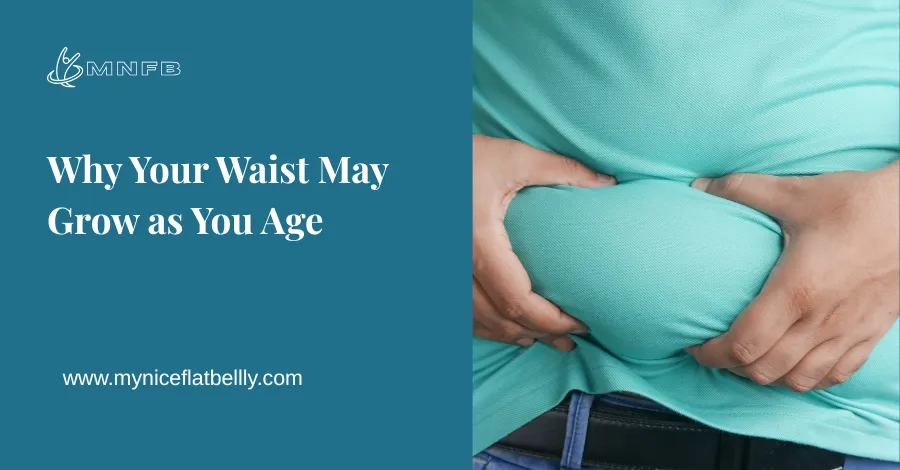
Why Your Waist May Grow as You Age
The short answer: as you get older, your body tends to lose muscle and gain fat, and fat builds up toward the center of the body, including around the internal organs. Muscle loss also slows how quickly the body burns calories. In women, lower estrogen after menopause is the likely reason for extra belly fat. So your waist can grow even if your weight barely changes. A simple check is to compare your waist with half your height every few months, not every day.
Why it happens
MedlinePlus, part of the US National Institutes of Health, describes several changes that come with age:
- Body fat goes up. The amount of body fat rises steadily after age 30, and older people may have almost one-third more fat than when they were younger.
- Fat moves toward the center. Fat builds up toward the middle of the body, including around the internal organs, and the layer of fat under the skin may become smaller.
- Muscle tends to shrink. After age 30, people tend to lose lean tissue, including muscle. Loss of muscle mass reduces strength.
- Weight often rises first, then falls. Men often gain weight until about age 55 and women until about age 65, and later weight loss is partly because fat replaces muscle, and fat weighs less.
Timing varies. Another MedlinePlus article says muscle changes often begin in the 20s in men and in the 40s in women, so treat any age as a rough guide, not a deadline.
The NIDDK, part of the same institutes, adds that older adults tend to lose bone and muscle and gain body fat, and that this can raise health risks even when BMI stays the same. That is why the scale or BMI alone may miss a change that a waist measurement picks up.
Menopause and where fat is stored
The NHS says that weight gain during perimenopause and menopause is common, and that it often happens around the stomach and upper body.
Mayo Clinic says many women notice more belly fat as they get older even if they do not gain weight, and that this is likely due to lower estrogen levels, because estrogen affects where the body stores fat. Harvard Health Publishing similarly says the loss of estrogen after menopause causes a slight shift of fat to the abdominal region.
Why your waist can grow without weight gain
Harvard Health Publishing gives a few reasons that are not about fat alone:
- We tend to lose muscle mass, so the abdominal muscles are not as tight as they once were.
- Loss of elastin and collagen lets skin sag.
- We lose height as the discs between the vertebrae compress, which shrinks the space in the abdominal cavity and pushes it outward.
MedlinePlus agrees that people lose height with age, typically almost half an inch (about 1 centimeter) every 10 years after age 40. That article is a general encyclopedia entry and the Harvard piece is a 2015 doctor’s Q&A, so treat these as explanations, not measurements of how much your own waist will change.
Muscle, calories and genes
Mayo Clinic says you lose muscle as you age, that muscle loss is worse if you are not physically active, and that loss of muscle mass slows down how quickly the body burns calories. It also says genes can contribute to where the body stores fat.
A note on new research
A 2025 study in Science, reported by ScienceDaily, found in mice that aging activates stem cells that produce new fat cells, and found similar cells in human tissue samples. The work is early and preclinical, and it does not change what anyone should do today. We mention it only because it may explain part of the picture in the future.
Why it still matters
The NIDDK says where your body stores fat matters. Extra fat in the upper body, especially around the abdomen, raises the risk of weight-related health problems. It also lists a large waist size as one of the conditions used to diagnose metabolic syndrome, which requires at least three of five conditions. We do not diagnose anything here. If you are concerned, speak to your GP or pharmacist.
What can help
MedlinePlus says lifestyle choices affect how quickly these changes happen. It recommends getting regular exercise, eating a healthy diet with fruits, vegetables, whole grains and healthy fats, and limiting alcohol.
A second MedlinePlus article says exercise is one of the best ways to slow or prevent problems with muscles, joints and bones, and that a moderate exercise program can help you maintain strength, balance and flexibility. It advises talking to your health care provider before starting a new exercise program.
None of this means a bigger waist is inevitable. Nor do we promise any change in your waist from any habit. These are the general lifestyle recommendations the source gives.
A simple way to keep track
- Measure your waist and your height, using the same method each time.
- Compare your waist with half your height, the NHS rule of thumb for waist-to-height ratio.
- Repeat every few months, not every day, and look at the trend.
- If you have a health condition, or you are worried about changes in your body, talk to a healthcare professional.
Use our waist-to-height ratio calculator to compare your waist with your height, or read What Is Waist-to-Height Ratio? for how it works and who should not use it.
What to realistically expect
Changes in your waist as you age are common and not a personal failing. A better aim than a particular number is steady habits you can keep, such as staying active and eating well, covered in our other guides.
- We cannot say how much your waist will change, or when. It varies from person to person.
- We do not give advice on hormones, medication or supplements. Please ask a healthcare professional about those.
- A bigger waist does not mean something is wrong, and a stable waist does not guarantee good health.
Frequently asked questions
Why is my waist getting bigger when my weight has not changed?
MedlinePlus says body fat builds up toward the center of the body with age and that muscle tends to shrink. The NIDDK says this can raise health risks even when BMI stays the same. Harvard Health Publishing also points to looser abdominal muscles, sagging skin and height loss as reasons the waist can widen without weight gain.
Is a bigger waist a normal part of aging?
It is common. MedlinePlus describes these changes as part of aging, and the NHS says weight gain around the stomach is common during perimenopause and menopause. Common does not mean unimportant, because the NIDDK says where your body stores fat matters for health risk.
Does waist size increase with age in men too?
MedlinePlus describes fat moving toward the center of the body and muscle loss for people in general, and says men often gain weight until about age 55. The menopause explanation applies to women. We did not find a verified source on hormones and the waist in men, so we do not offer one.
Can exercise stop my waist growing?
We cannot promise that. MedlinePlus says lifestyle choices affect how quickly these changes happen and recommends regular exercise, a healthy diet, and limiting alcohol. It says a moderate exercise program can help maintain strength, balance and flexibility.
When should I talk to a doctor?
If you have a health condition or you are worried about your waist size or changes in your body, the NHS suggests contacting your local pharmacist or GP surgery. MedlinePlus advises talking to your health care provider before starting a new exercise program.
Sources
- MedlinePlus: Aging changes in body shape
- MedlinePlus: Aging changes in muscles, bones, and joints
- NIDDK: Am I at a healthy weight?
- NIDDK: Health risks of overweight and obesity
- NHS: Menopause symptoms
- Mayo Clinic: Belly fat in women
- Harvard Health Publishing: My waist has expanded, but I haven’t gained weight (2015)
- ScienceDaily: report on the 2025 Science study of fat cells and aging
This article is general education, not medical advice. Read our disclaimer and editorial policy.
Pingback: Fiber Benefits — Why Fiber Matters and Simple Ways to Eat More
Pingback: Does Walking Reduce Belly Fat? What the Guidelines Say
Pingback: What Is Waist-to-Height Ratio?
Pingback: Can cardio burn stomach fat? hat the Research Says
Pingback: 7 Habits Of Healthy Living - My Nice Flat Belly
Pingback: How to Get Rid of Belly Fat: What Health Authorities Actually Say
Pingback: Mindful eating and weight loss - 7 Practical tips - My Nice Flat Belly